
The below are all the chess game types that can be played on a standard 8×8 playing field. So if you are interested in playing chess but in a different way or version, below you can find more information about the games and the associated rules.
Standard Chess
Chess is a two-player strategy board game that is played on an 8×8 grid called a chessboard. The game consists of 32 pieces: each player controls 16 pieces, including a king, queen, two rooks, two bishops, two knights, and eight pawns. The objective of chess is to checkmate the opponent’s king, meaning that the king is in a position to be captured (“in check”) and has no legal moves to escape.
Each player takes turns moving one piece at a time. Capturing occurs when a piece lands on a square occupied by an opponent’s piece. The game revolves around tactics, like pins, forks, and skewers, as well as strategy, which involves planning long-term attacks and defenses.
Chess involves deep thought, pattern recognition, and planning ahead, making it one of the most popular and intellectually stimulating games in the world.
Atomic Chess
Atomic Chess is a chess variant that introduces explosive dynamics to the game. The basic rules of chess apply, but with a key twist, when a piece is captured, an “explosion” occurs. This explosion affects not only the captured piece but also all pieces (except pawns) on adjacent squares. The resulting blast eliminates both friendly and opposing pieces, creating chaotic and strategic opportunities.
Key rules of Atomic Chess:
- Capturing and Explosions: When you capture a piece, the explosion destroys all surrounding pieces (except pawns), including your own if they are adjacent to the captured piece. For example, if a knight captures a bishop, both the knight and all adjacent pieces are destroyed.
- Kings Can’t Be Captured: The traditional rule of check and checkmate doesn’t apply here. Instead, you win by causing an explosion that takes down your opponent’s king. Directly capturing the king is not allowed.
- Pawns are Special: Pawns are immune to explosions. They can capture and cause explosions, but they will not be affected by them. This gives pawns an added layer of importance in both offense and defense.
- Checkmate Concept: There is no traditional checkmate in Atomic Chess. The objective is to use explosions strategically to eliminate the opponent’s king.
Atomic Chess offers a fresh tactical challenge. Sacrificing pieces to initiate a beneficial explosion or forcing your opponent into a self-destructive capture are key elements of success. The game’s emphasis on sudden, sweeping changes makes planning critical, but players must also adapt to the game’s inherent chaos. This variant is perfect for those looking for a fast-paced, tactical, and explosive spin on traditional chess!
Blitz Chess
Blitz Chess is a fast-paced version of standard chess where each player has a limited amount of time to make all of their moves. In Blitz, both players typically have 3 to 5 minutes on their clocks, with or without a small time increment per move (often 2 seconds). The game is conducted under strict time controls, and time management is just as crucial as the moves made on the board.
Key features of Blitz Chess:
- Time Control: Each player must complete their game in the designated time (e.g., 3+2 means 3 minutes with a 2-second increment per move). If a player’s time runs out, they lose the game unless the opponent cannot checkmate them.
- Fast Decision-Making: Due to the short time frame, players must make quick decisions, often relying on intuition and pattern recognition rather than deep calculation.
- High Pressure: The ticking clock adds intensity to Blitz, and many games are decided on time rather than position.
Blitz chess tests both speed and skill, making it popular among players of all levels. It’s frequently played online as well as in casual settings, providing a thrilling and rapid chess experience.
Bughouse Chess
Bughouse Chess is a fast-paced, team-based chess variant played by four players divided into two teams. The games are conducted on two chessboards, and teammates sit next to each other, playing against the opposite team.
Key Rules of Bughouse Chess:
- Team Play: Each team consists of two players. One plays white on one board, while the other plays black on the second board.
- Piece Sharing: The most distinctive rule in Bughouse is that captured pieces are passed to the teammate. For example, if you capture an opponent’s rook, you can hand it to your partner, who can place it on their board as their own piece on their next turn.
- Piece Placement: The placed piece can be put on any empty square (except pawns cannot be placed on the 1st or 8th ranks).
- Time Control: Usually, Bughouse is played with fast time controls, and the game can be very dynamic and tactical.
- Winning: A team wins when either player checkmates their opponent or when one of the opponents runs out of time.
Bughouse combines speed, strategy, and coordination between teammates, making it a chaotic and fun variation for those looking for an exciting twist on traditional chess.
Bullet Chess / Lightning Chess
Bullet chess games are quick games that take less thatn 3 minutes per player.
If you want even faster games you might considering Hyperbullet / Ultrabullet games which are 30 and 15 second per player games.
Kung-fu Chess
This is an online version of chess that doesn’t use turn but rather is a real-time action chess variant. How it works is that you can move any piece at any moment you want. Your opponent can make multiple moves while you do nothing. Once you have moved a piece there is a cooldown period before you can make the next move with this piece but in the meantime you can position anything you want. This is chaos but also very strategic as timing can be very crutial in being successful in these type of games. Below are websites where you will be able to play this version of chess:
Minichess
> Minichess variant: Knight Court
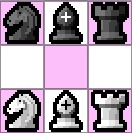
This game was created by Jason D. Wittman. The game is played on a board of three by three squares. The opening setup is as the image to the left.
The players start with a knight, bishop, and rook, in that order on their home row. There is no King in this game because the object is to checkmate the Knight. All the pieces move as in normal chess. Rules regarding check and checkmate that would normally apply to the king here apply to the knight.
Also, when a piece is captured, the owner of that piece may ‘drop’ that piece onto an empty square on any subsequent turn (this is like Shogi, except the pieces do not change owners. White pieces remain white and are dropped by the white player, and the same goes for Black). This means, of course, that capturing a piece is not always a good idea.
Important: It is illegal to move back and forth between the same positions (in other words, no draw by three-move repetition). Both players must vary their moves.
> Minichess variant: Silverman Chess
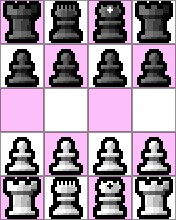
The mathematician David Silverman suggested in 1981 a 4×4 chess variant. The goal of the game was the same as classic chess however there was a fixed set of movements for an automatic win for the starting player.
Therefore David suggested to add a 5th row in between the opposing pawns to make the game more playable. Additional rule for this variant of minichess is that the pawns are allowed to move 2 squares from their starting position only is the target square is empty.
> Minichess variant: Baby Chess

A variaty of a 5×5 chessboard with all the standard classic chess rules. The first version of this was suggested by Martin Garnder in 1969.
The years after changes were made to better. In 1989 Martin made another suggestion to the start setup of the game to make it more balace which is called Baby Chess. In this version of minichess the start setup is similar but black is setup mirrored.
> Minichess variant: Microchess

This variant of Minichess was greated by Glimne in 1997. In this we use s board of 4 wide x 5 long. There is no queen in the game at setup and only 1 single pawn. The standard classic chess rules apply with the exceptions being:
- Pawns are not allowed to double move
- Castling is not allowed
- Pawns can promote as normal also into a queen
Peasants’ Revolt
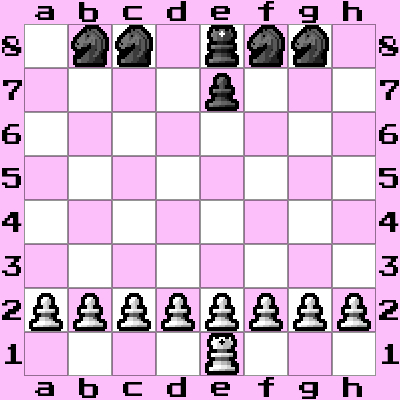
White acts as the peasants here with 1 king and 8 pawns. Black acts as the nobles with 1 king, 4 knights and 1 pawn.
In this variant of chess Black has the advantage. Depending on the skills of your opponent you might want to consider to setup with 1 less knight. All standard classic chess rules apply.
Pre-chess
Pre-Chess is a chess variant introduced by Grandmaster Pal Benko in 1978. The aim of the game is to diversify opening play and reduce reliance on memorized sequences. In this variant, while pawns start on their usual ranks, players have the freedom to arrange their back-rank pieces (king, queen, bishops, knights, and rooks) in any desired order before the game begins.
This setup phase allows for 8,294,400 possible initial configurations, significantly increasing the variety of opening positions. Once both players have placed their pieces, the game proceeds according to standard chess rules. Castling is permitted only if the king starts on e1/e8 and the rooks on a1/a8 or h1/h8, adhering to traditional castling conditions.
Pre-Chess encourages creativity and strategic planning from the outset, as players must consider the strengths and weaknesses of their chosen piece arrangement. This variant offers a fresh challenge by eliminating established opening theory, compelling players to rely on fundamental principles and adaptability.
Shuffle Chess / Fischer Random Chess / Chess960
Fischer Random Chess, also known as Chess960, is a chess variant invented by Bobby Fischer in 1996. Bobby, like Pal Benko tried to do, wanted to reduce the reliance on memorized openings and encourage creativity. The game follows the same rules as standard chess but with one major difference: the starting position of the back-rank pieces is randomized.
Before the game begins, the placement of the king, queen, bishops, knights, and rooks is determined according to specific constraints:
- The king must be placed between the two rooks.
- The bishops must be on opposite-colored squares.
- Pawns remain in their standard starting position.
There are 960 possible starting setups, hence the name “Chess960.” The game proceeds like regular chess, with castling still allowed under modified rules to ensure the king and rook end up in their standard castled positions.
Fischer Random Chess eliminates extensive opening preparation, forcing players to rely on strategic thinking from the very first move. This variant is popular among both casual and professional players, as it emphasizes adaptability, creativity, and pure chess skill over memorization. It has been officially recognized by FIDE (the International Chess Federation) and is played in world championship events.
Upside-down chess
Upside-Down Chess is a chess variant that flips the traditional starting position, creating a unique and challenging gameplay experience. In this variant, each player’s pawn row and back-rank pieces are swapped, meaning the major pieces (king, queen, rooks, bishops, and knights) start in front, while the pawns begin on the second rank.
This reversal drastically changes the nature of the game. Since powerful pieces are immediately active, early attacks and tactics become more common, and traditional opening principles no longer apply. Players must be cautious, as their king is exposed from move one, making quick checkmates a frequent threat.
Another key difference is pawn movement. Since pawns are placed behind the main pieces, their usual early role in controlling the center is diminished. Instead, they must navigate around the major pieces before advancing. This creates a new layer of strategy, as players must carefully develop their position while ensuring their king’s safety.
Upside-Down Chess is a fun, fast-paced variant that encourages aggressive play and forces players to rethink standard chess principles. It is popular among those looking for a fresh and unpredictable chess experience, emphasizing tactical skill over deep opening preparation.